Freemasonry is one of the world’s oldest and most influential fraternal organizations, with roots that blend medieval craft traditions, Enlightenment philosophy, and symbolic ritual. Its history is a mix of documented evolution and long-standing legend.
🏗️ Origins: Medieval Stonemasons (c. 1100–1500s)
Freemasonry traces its earliest roots to the guilds of operative stonemasons in medieval Europe. These were skilled builders responsible for cathedrals and castles.
They formed tight-knit groups with trade secrets, passwords, and hierarchies.
Lodges (local groups) served as both workplaces and social organizations.
Symbols like the compass and square come directly from these builders’ tools.
🔄 Transition to “Speculative” Masonry (1500s–1600s)
As cathedral-building declined, lodges began admitting non-masons—educated men interested in philosophy, science, and ethics.
This shift turned Freemasonry into a symbolic or “speculative” society.
Members used stonemason tools as metaphors for moral and personal development.
📜 Formation of Modern Freemasonry (1717)
A major milestone came in 1717 with the founding of the
Premier Grand Lodge of England in London.
This is considered the birth of organized, modern Freemasonry.
In 1723, James Anderson published the Constitutions of the Freemasons, outlining rules and principles.
Freemasonry spread rapidly across Europe and the American colonies.
🌍 Enlightenment Influence (1700s)
Freemasonry flourished during the Age of Enlightenment, emphasizing:
Reason and scientific inquiry
Religious tolerance
Brotherhood and equality (within limits of the time)
Many prominent figures were associated with Freemasonry, including:
George Washington
Benjamin Franklin
Voltaire
⚖️ Suspicion and Opposition (1700s–1800s)
Freemasonry’s secrecy led to suspicion and backlash:
The Morgan Affair in the U.S. sparked a strong anti-Masonic movement.
The Catholic Church officially condemned Freemasonry multiple times.
Some governments banned it, fearing political influence.
🏛️ Growth and Global Spread (1800s–1900s)
Despite opposition, Freemasonry expanded worldwide:
Lodges formed across Europe, the Americas, Africa, and Asia.
It became associated with civic leadership and philanthropy.
Different branches developed, including rites like the Scottish Rite and York Rite.
🌐 Modern Freemasonry (1900s–Today)
Today, Freemasonry is a global fraternity focused on:
Personal development
Charity and community service
Fellowship and tradition
Key features:
Organized into local lodges under regional “Grand Lodges”
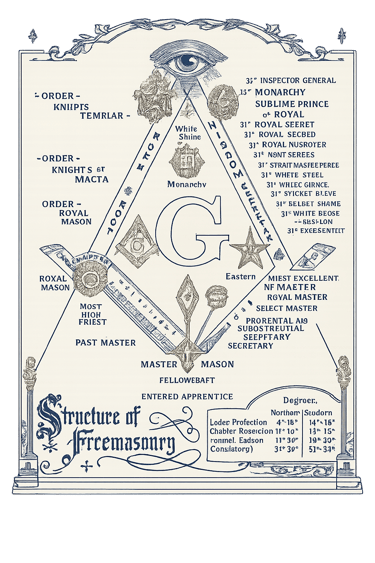
Rituals and degrees (typically three main degrees: Entered Apprentice, Fellow Craft, Master Mason)
Membership often requires belief in a higher power (varies by jurisdiction)
History of Free Masonry